

The dream of owning a home in sun-drenched Valencia is a powerful one. Yet, for many international buyers, this vision is often clouded by…

The Best Neighbourhoods in Valencia: An Expat’s Guide for 2026
Valencia’s sun-drenched streets are calling, but the dream of a new life can quickly become overshadowed by one complex question: where, exactly,…

Valencia Property Market Trends 2026: A Buyer’s Guide
Is 2026 the year to finally secure your dream home in Valencia, or are you concerned about buying at the market’s peak? For many international…

Cost of Living in Valencia: A Complete Expat Guide for 2026
Are you dreaming of Valencia’s sun-drenched plazas but find yourself bogged down by confusing online calculators and vague salary estimates? It’s a…

How to Rent an Apartment in Valencia: A Strategic Guide for Expats
Valencia’s sun-drenched streets and vibrant culture are calling, but the dream of a new life can quickly be overshadowed by the daunting reality of…
💰 How to claim the €3.000 energy efficiency subsidy in Valencia (2026 extension)
Spain has officially extended the Next Generation EU tax deductions and subsidies for home energy efficiency upgrades until 2026. Specifically, homeowners in Valencia can claim a deduction of up to 40% (€3.000) by reducing their heating and cooling demand by at least 7%. To qualify, an Energy Performance Certificate (EPC) must be obtained before and after the works are carried out. This ultimately makes 2026 the best year to modernise your Valencian home while significantly reducing your tax bill. 1. The 2026 extension: Why the government is paying you Backed by European recovery funds, the Spanish government is committed to decarbonising the housing stock. Many older buildings in Valencia’s city centre, such as those in Ruzafa and Extramurs, are energy-efficient ‘dinosaurs’. Consequently, the authorities have extended the deadline for these tax breaks to 31 December 2026. This is not just a direct grant, but a substantial tax deduction on your IRPF (income tax), meaning the government effectively offsets a large proportion of your renovation costs. 2. Which renovations qualify for the €3.000 deduction? Not all “fixer-upper” projects qualify. Specifically, the work must demonstrably improve the building’s thermal performance. Eligible projects include: The magic numbers: To qualify for the 40% deduction (up to a limit of €3,000), you must demonstrate a reduction in heating and cooling demand of at least 7%. Alternatively, you can unlock higher tiers of the subsidy by achieving a 30% reduction in non-renewable primary energy. 3. The secret weapon: the Energy Performance Certificate (EPC) You cannot claim this subsidy without the correct paperwork. Therefore, the Energy Certificate is the most important document. Crucially, the post-renovation certificate must demonstrate a 7% improvement. Therefore, it is vital to work with an experienced architect or contractor who understands these metrics. 4. Maximising your ROI in 2026 Combining this subsidy with Valencia’s climate is a financially sensible decision. For example, installing high-quality windows not only gets you a tax break, but also: 5. How a personal shopper can help you For foreigners, navigating Spanish bureaucracy for subsidies can be a nightmare. However, we make it simple! Specifically, we help by: ❓ Frequently Asked Questions (FAQ)

Buying Property in Valencia, Spain: The Ultimate Guide for Expats
The dream of a sun-drenched life in Valencia is powerful, but the path to owning a home here can feel clouded with uncertainty. For many expats, the…
🚫 The top five mistakes international buyers make in Valencia (and how to avoid them)
Buying property in Valencia can be an exciting experience. However, many international buyers unwittingly fall into expensive traps. The most common mistakes involve trusting the wrong people or ignoring local legalities. For example, relying solely on a seller’s agent or skipping technical inspections can be disastrous. Furthermore, many buyers fail to budget for additional costs of 12–15%. Working with an independent personal shopper can help you to avoid these pitfalls. Ultimately, your investment will remain secure and profitable in 2026. 1. Mistake: Relying solely on the seller’s agent This is the most common mistake made by foreigners. Many people mistakenly assume that the agent works for both parties. 2. Mistake: Underestimating the total cost of acquisition Many buyers only budget for the price of the property. Consequently, they are hit with a huge financial shock at the notary’s office. 3. Mistake: Assuming the notary performs due diligence Foreign buyers often mistakenly believe that the notary protects them from legal issues. However, this is a dangerous misconception. 4. Mistake: Skipping a professional technical inspection Many buyers are attracted to the ‘Bohemian charm’ of old Valencian flats. Consequently, they overlook what lies beneath the surface. 5. Mistake: Ignoring local rental and zoning laws Valencia’s laws on tourist rentals underwent significant changes in 2025 and 2026. Many buyers still assume that they can easily rent out their property on Airbnb. ❓ Frequently Asked Questions (FAQ)
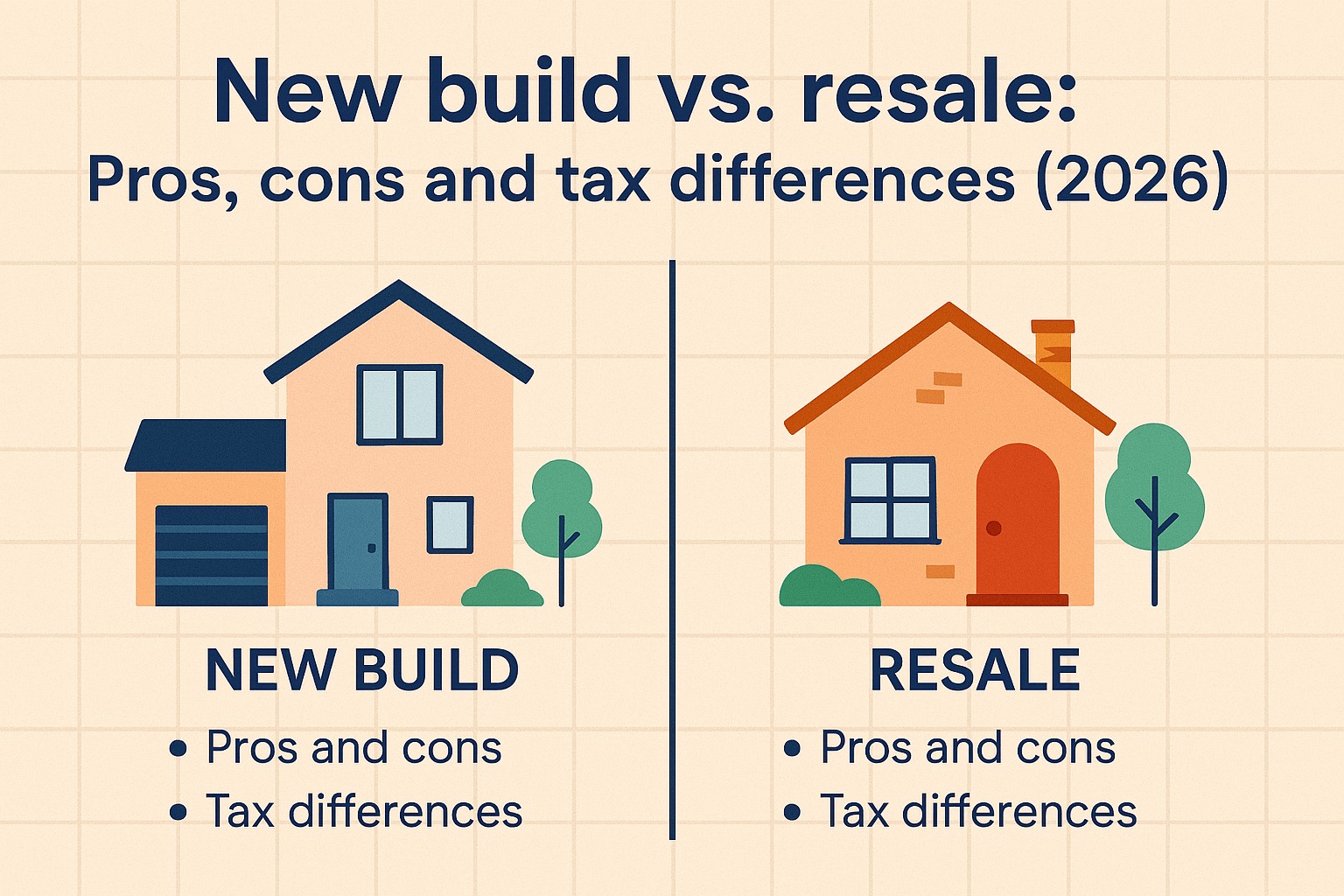
🏗️ New build vs. resale: Pros, cons and tax differences (2026)
When choosing between a new-build and a resale property in Valencia, you have to decide whether to prioritise location or efficiency. Specifically, new builds tend to have superior energy ratings and require less maintenance. Conversely, resale properties tend to be in the most central and iconic locations. The tax landscape in Valencia is set to change in 2026. A significant reduction in resale tax (ITP) comes into effect on 1 June. Understanding these fiscal shifts and lifestyle differences is therefore crucial for making a smart investment this year. 1. The financial landscape: Tax differences in 2026 The amount of tax you pay depends entirely on whether the property is ‘brand new’ or ‘pre-owned’. Furthermore, due to new regional laws, the timing of your purchase in 2026 matters immensely. A. Buying a new build (obra nueva) If you buy from a developer, you will have to pay two main taxes. B. Buying a resale property (segunda mano) If you are buying a pre-owned home, you will need to pay the Property Transfer Tax (ITP). The strategy: If you’re looking to buy a resale home for under €1M, it could be worth waiting until June, as you could save €2,500 for every €250,000 spent. 2. New builds: The case for modernity New developments in Valencia, particularly in districts such as Quatre Carreres and Nou Campanar, offer a ‘hands-off’ lifestyle. 3. Resale properties: The case for location and soul If you want to live in the heart of Ruzafa or Ciutat Vella, buying a resale property is your only option. 4. Direct comparison: At a glance Feature New build (obra nueva) Resale (segunda mano) Primary Tax 10% IVA + 1.4% AJD 9% ITP (from June 2026) Condition Perfect / Modern Varies / Often needs renovation Maintenance Very Low Higher / Periodic “Derramas“ Speed Slow (if off-plan) Fast (usually 2–3 months) Location Emerging districts Established city center 5. Why a personal shopper real estate is vital for both We help you navigate the unique risks of each path. Specifically, we provide the protection you need most. ❓ Frequently Asked Questions (FAQ)

🏦 Banking for foreigners: How to get a mortgage in 2026
In 2026, securing a mortgage in Spain as a foreigner is highly achievable. Specifically, the market has entered a stable phase, with interest rates currently ranging from 2.8% to 3.5%. Non-residents can usually borrow between 60% and 70% of a property’s value. To succeed, you must demonstrate a debt-to-income ratio of below 35%. The keys to swift approval are the early preparation of apostilled documents and a local bank account. 1. The 2026 mortgage climate: Stability and opportunity The Spanish mortgage market in 2026 is characterised by predictability. Indeed, the 12-month Euribor rate has stabilised at around 2.2%. This creates favourable conditions for both fixed and variable products. 2. Loan-to-value (LTV): Calculating your deposit Spanish banks treat residents and non-residents differently in terms of risk. Therefore, you should be prepared for stricter ‘leverage’ limits. 3. The ‘survival kit’ documentation Spanish banks are meticulous about paperwork. Specifically, all foreign documents must be officially translated and often ‘apostilled’. Essential personal documents: Financial proof (The “solvency” pack): 4. The 35% “effort rate” (DTI) Spanish lenders place a strong focus on your debt-to-income (DTI) ratio. Specifically, they calculate your ‘effort rate’ to ensure that you are not over-leveraged. 5. Why a specialist broker or personal shopper is vital Navigating Spanish banks from abroad can be a real headache. However, having professional representation can make all the difference. ❓ Frequently Asked Questions (FAQ)


